Businesses that use Bulk SMS service often apply for a masking name so their brand appears as the sender instead of a random phone number. When customers receive a message, they see the company name rather than a numeric sender. This increases trust and helps customers quickly recognize the source of the message.
However, while sending masking sms many masking applications are delayed or rejected because of missing or incorrect documents. Telecom operators review masking requests carefully to prevent spam, fraud, or impersonation. If the required documents are incomplete or unclear, the approval process stops until proper verification is completed.
Preparing the correct documents before applying helps businesses avoid repeated submissions and get approval faster.
Why Documents Are Required for Masking Approval
Telecom operators require documents to confirm that the business requesting the masking name is legitimate and authorized to use that identity. Without verification, anyone could send messages pretending to represent a company or institution.
Documents help telecom operators verify several key things:
The business is a legitimate organization:
Registration documents confirm that the company actually exists and operates legally.
The masking name belongs to the business:
Documentation ensures the sender name represents the correct brand or organization.
The applicant is authorized to submit the request:
Identification documents help verify the person responsible for the SMS communication.
When these points are verified clearly, the approval process becomes faster and smoother.
Checklist of Documents Required for Masking Approval
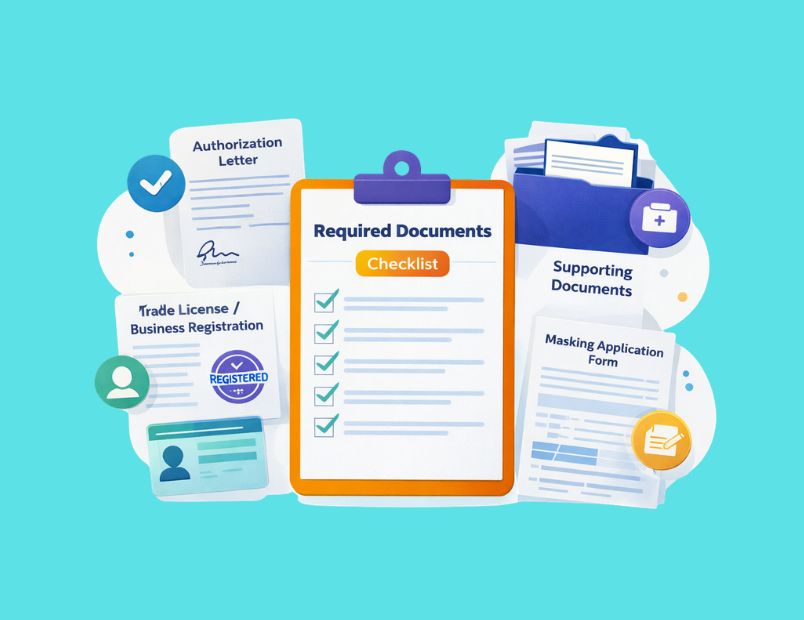
Quick Snapshot: Documents Required for Masking Approval
| Document | Purpose | Key Requirement |
| Authorization Letter | Confirms the organization approves the masking name | Must include company name, masking name, SMS purpose, and authorized signature |
| Trade License / Business Registration | Verifies the business operates legally | Business name should match the requested masking name |
| National ID / Personal Identification | Confirms the identity of the applicant | Must be clear and valid identification |
| Masking Application Form | Collects information required for telecom approval | Must be filled accurately and completely |
| Supporting Documents (if required) | Provides additional verification when needed | Brand ownership proof or institutional verification |
Lets get into details now. Before submitting a masking request, businesses should prepare several essential documents. Each document serves a specific purpose in the verification process.
1. Authorization Letter from the Organization
An authorization letter confirms that the organization officially approves the use of the masking name for SMS communication.
Key points about this document include:
- It confirms sender identity:
The letter states that the organization allows the masking name to represent the business in SMS messages. - It must include official details:
The letter typically contains the company name, the requested masking name, and the purpose of using SMS. - It should be signed by an authorized person:
A company owner, manager, or official representative usually signs the document.
Telecom operators rely on this letter to verify that the sender identity is genuine. Applications are often rejected when the authorization letter is missing, unsigned, or incorrectly formatted.
2. Business Registration or Trade License
A trade license or business registration document proves that the organization operates legally. Important aspects of this document include:
- It verifies business identity:
Telecom operators check this document to confirm that the organization exists and is registered. - It links the masking name to the business:
The masking name should closely match the company or brand name shown in the document. - It helps prevent impersonation:
Without legal verification, someone could attempt to use another company’s brand name.
Businesses should ensure that the name used in the masking request matches the official business identity in the registration document.
3. National ID or Personal Identification
Telecom operators also require identification from the person submitting the application. This helps verify the individual responsible for the request.
Key reasons for this requirement include:
- Confirming applicant identity:
The national ID or passport shows who is applying for the masking approval. - Ensuring accountability:
If misuse occurs, the telecom operator can identify the responsible person. - Verifying authorization:
The applicant must be connected to the organization requesting the masking name.
Providing clear and valid identification reduces the chance of verification delays.
4. Masking Application or Request Form
Most masking SMS providers in Bangladesh require a formal application form to process masking requests. This form collects essential information needed for telecom approval.
The form usually includes:
- The masking name being requested
- Organization details such as company name and contact information
- The purpose of using SMS communication
Completing this form accurately is important. Incomplete or incorrect forms are a common cause of masking rejection. Reviewing all information before submission helps avoid unnecessary delays.
5. Supporting Documents (If Needed)
In certain cases, telecom operators may request additional documents depending on the organization type or masking name.
These may include:
- Brand ownership proof:
If the masking name represents a well-known brand, proof of ownership may be required. - Institutional verification:
Schools, clinics, or government-related organizations may need to provide additional verification documents. - Authorization from parent organizations:
If the brand belongs to a larger organization, permission may be required to use the name.
Providing supporting documents when necessary helps complete the verification process faster.
Common Document Mistakes That Cause Rejection
- Submitting unclear or low-quality document copies that cannot be properly verified
- Missing signatures on required documents
- Providing documents where the business name does not match the requested masking name
- Authorization letter not clearly mentioning the masking name
- Authorization letter not stating the purpose of SMS communication
- Incomplete documentation or missing required files
- Inconsistent information across submitted documents
Preparing clear, complete, and consistent documents helps increase the chances of masking approval.
How Proper Documentation Speeds Up Approval
When documents are prepared correctly, telecom operators can verify the masking request quickly. Clear authorization letters, valid business documents, and accurate application forms reduce the need for additional clarification.
This preparation minimizes the back-and-forth communication that often causes approval delays. Businesses that prepare documents carefully can often complete the approval process much faster.
How SMS Providers Help with Masking Approval
Experienced Bulk SMS providers play an important role in simplifying the masking approval process. Providers familiar with telecom requirements can guide users through the documentation process and ensure applications follow the correct format.
For example, platforms such as Khudebarta assist businesses in preparing authorization letters, verifying application details, and submitting requests properly. This support helps reduce the risk of rejection, especially for first-time users.
Working with a provider that understands telecom compliance makes the approval process much easier.
Final Thoughts
Masking approval depends heavily on proper documentation. Many applications are rejected not because of the masking name, but because the required documents were incomplete or incorrectly prepared.
By preparing the authorization letter, business registration documents, identification records, and application forms in advance, businesses can significantly improve their chances of approval.
A clear checklist and proper guidance help ensure that masking requests are approved on the first attempt, allowing businesses to begin sending branded SMS messages without unnecessary delays.